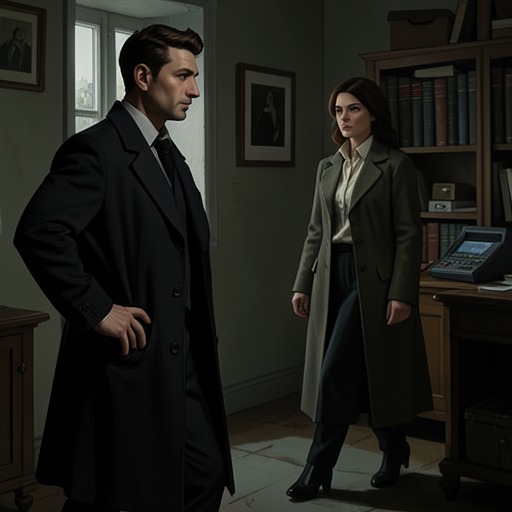
The theater attack on Delilah
Box Set: Samsons Sterbliche Geliebte & Samson's Lovely Mortal (Deutsch·Englisch) (Scanguards Vampire) (German Edition)The theater attack on Delilah is a pivotal confrontation in which a planned romantic evening with Samson Woodford is abruptly transformed into an armed threat. Its decisive significance lies in the double pressure it places on Samson: he must protect Delilah from a gunman while concealing the speed, strength, and fangs that would reveal him as a vampire. For Delilah, the attack converts attraction into fear for Samson’s life, while its later investigation establishes that the danger around her is deliberate rather than accidental.
Causes and Background
The attack occurs during an evening that Samson has arranged for himself and Delilah. Their intimacy is already intensifying when a threatening male voice orders them against the wall and breaks the moment. The assailant’s pistol makes the danger immediate, but Samson understands that the greater risk is not only physical injury. If he responds with his supernatural abilities, Delilah may discover that he is not what he appears to be. His vampire identity must therefore remain hidden even while the attack forces him into the role of her protector.
The incident is not treated as an isolated street crime. Delilah later faces another attack, and Samson tells Billy that being attacked twice by the same man in San Francisco cannot be a coincidence. Billy admits that he was paid, confirming that the violence is part of an organized attempt to reach Delilah rather than an opportunistic assault. The theater attack thus becomes the first clear link between Delilah’s personal danger and the hidden chain of intimidation surrounding her.
What Happens
A male voice cuts through the silence and commands Samson and Delilah to face the wall. Samson immediately turns toward the threat and sees a large man aiming a pistol at them. Delilah trembles in his arms, and Samson draws her protectively against him. The physical arrangement is crucial: he places his body between her and the weapon, making protection visible as an act of position and restraint rather than an exhibition of supernatural force.
Samson cannot use his extraordinary speed or his fangs without frightening Delilah and exposing the secret he has guarded. Instead, he uses the only weapon he can safely reveal: mind control. He orders the attacker not to shoot and tells Delilah to do as he says and stand behind him. She obeys while fearing that the gunman will kill Samson. The scene therefore reverses the apparent balance of power. The armed attacker seems to control the space, but Samson quietly controls the attacker’s decision, while Delilah’s trust is tested in the narrow space behind Samson’s back.
The confrontation also changes the value of the evening itself. What began as courtship becomes a life-threatening encounter, and Samson’s desire for closeness is forced into conflict with his need for concealment. He continues to protect the evening and the woman in his arms, but he must do so through a performance of human vulnerability. The attack is consequently both an action scene and a near-exposure of the supernatural truth beneath Samson’s carefully maintained public identity.
Immediate Consequences
The attack leaves Delilah shaken even after the immediate danger has passed. She cannot dismiss Samson’s willingness to place himself between her and a gunman; she continues to picture the possibility that he could have been injured. When Oliver later discusses the incident with her, he says that she was fortunate to have been with Mr. Woodford and insists that Samson can take care of himself. Delilah nevertheless remains troubled by the thought that he took such a risk, and Oliver recognizes that her concern reveals her growing affection for Samson.
The attack also strengthens Samson’s protective relationship with Delilah while preserving the asymmetry of what each knows. She experiences him as exceptionally capable and courageous, but she does not yet understand that his restraint is motivated by the need to conceal vampirism. Samson, meanwhile, learns that protecting her may require him to suppress precisely the abilities that would make protection easiest. The emotional consequence is therefore inseparable from the strategic one: her trust deepens at the same time that his secret becomes more burdensome.
Investigation and Recurrence
The theater attack gains further significance when it is connected to the later assault commissioned against Delilah. Samson confronts Billy and demands an explanation for why someone is pursuing his wife, emphasizing that repeated attacks by the same man cannot be random. Billy’s admission that he was paid supplies the motive’s immediate outline and turns Delilah from a seemingly vulnerable passerby into the target of a paid operation.
The broader pattern includes danger in public and semi-public spaces. Delilah is later caught in heavy rain only a few blocks from her apartment, where she encounters a scarred man and follows the survival principle that an attacker must never be allowed to move a victim to a second location. On another occasion, she leaves Samson and hears a motorcycle approaching her from behind on a dark street lined with iron-gated apartment buildings. These parallel situations show how the theater attack belongs to a recurring structure of pursuit: a vulnerable target, limited effective protection, and an attacker attempting to convert an exposed public setting into private control.
The response to that structure comes through the Scanguards network. Thomas and Ricky investigate a house after hearing a woman screaming and a child crying, while Samson’s allies pursue the people involved in the attacks. The theater incident therefore helps broaden the story from a romance interrupted by violence into a coordinated investigation involving surveillance, hired criminals, and protective intervention.
Narrative Significance
The theater attack dramatizes the conflict between the conventional romance script of male protection and the novel’s more unstable distribution of agency. Samson initially occupies the familiar position of the powerful man shielding a frightened woman, but his apparent human role is itself a performance. Delilah’s later actions complicate the pattern: she becomes an auditor investigating fraud, challenges people who threaten her, and ultimately offers her own blood when Samson is gravely wounded. Her compassion is not passive. When he lies dying, she refuses to let him die and gives him blood directly from her vein, declaring that she cannot imagine living without him and that she wanted him despite the consequences.
In this progression, the theater attack is the first major occasion on which Samson’s protection and Delilah’s emotional investment become inseparable. The gunman’s weapon threatens bodily safety; Samson’s hidden nature threatens the possibility of honest intimacy; and the later revelation of the hired attack threatens Delilah’s freedom to move through ordinary life. The event answers the immediate threat through Samson’s mind control, but it cannot solve the larger problem. Instead, it creates the emotional and investigative momentum that carries the relationship from guarded attraction toward mutual dependence, confrontation, and eventual commitment.